When we all lived in the forest
  • Home
  • Fantasy Reading
  • Science Fiction Reading
  • Publications
  • Amusements
  • Moth Books

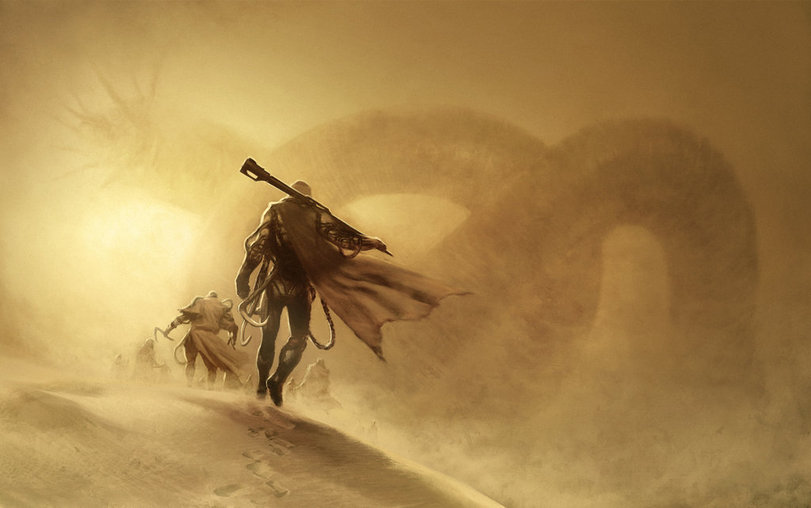
#100: Dune by Frank Herbert

7/29/2015

0 Comments

 
I first read Dune when I was in eighth grade.  That first time I read it, when I got to the end, I flipped it back over and read it again.  Then I read it again and again, once a year through my teens and twenties, perhaps twice in my thirties, and once in my forties for this "100 Great Books of Science Fiction List," and I have just read it again, at the half century mark of fifty.

I was flabbergasted by Dune when I first read it, and I am again, just now, finishing it again.  Not because  it isn't flawed (there are flaws); not because of the intelligent use of sense of smell to evoke reality (the spice, the smell of the sietch, the salt of Caladan's ocean); not because of the artful weaving of scenes which completely are their own creatures but create something much more cohesive and greater in my mind; not because of the powerful and realistic portrayals of women; not because of dozens of other reasons why Dune is the best book science fiction has ever produced.

No, I am stunned because, for the very first time, in the first chapter I realized that Frank Herbert had to be a Buddhist. There was no way he could not be.  No way...

I looked it up: yes, Frank Herbert had converted from Catholicism to Zen Buddhism in the Sixties.  The Catholic and Muslim overtones of Dune had always been overt, exotic, and delicious in a way other books don't seem able to embrace: but as I read on, I also realized that this book could not have have existed without this particular philosophical spine and musculature.  At certain points in the book, the characters speak (and oft become) koans.  

I am wondering what else Dune will give to me (that I previously had no idea was there) in my future readings.

When I first reviewed this in 2008 for this list (and lost the review), I remember saying that a book need not be perfect to be great.  This time, I am going to lift a passage from Thomas Merton, that I read just today.  (As an aside, Frank Herbert took six years to write Dune.  This may be why the other books in the series do not speak to me the way Dune does. I'm thinking they must have been written much for quickly.) 

"In any case it is depressing that those who serve God and love Him sometimes write badly, when those who do not believe in Him take pains to write so well.  I am not talking about grammar and syntax, but about having something to say and saying it in sentences that are not half dead. ...Imperfection is the penalty of rushing into print.  And people who rush into print too often do so not because they really have anything to say, but because they think it is important for something by them to be in print.  The fact that your subject may be very important in itself does not necessarily mean that what you have written about it is important."

Thank you, Thomas Merton.  And thank you, Frank Herbert.  Thank you so much.
Picture
0 Comments

#98: The Many-Coloured Lands by Julian May

3/28/2015

0 Comments

 
Picture
In the year 2050, a one-way worm hole provides an escape route for disgruntled humans back to the Pliocene. They are immediately enslaved upon their arrival -- by elfish aliens who have also settled there..

The only thing I remember from my original 2008 review of this book was that the Pliocene served as a basic backdrop for this story, and not much more: that still stands.  For this reading, I found this book was too long and paced too slowly, which I am sure continues with the remaining two books in the trilogy, The Golden Torc  and The Nonborn King.  This is a quest, so I think it is written strongly, but the genre throws me off, even clothed in science fiction rather than fantasy. 
Julian May, born in 1931, had written a lot of series, and is still writing!

I think the gigantic battle-ending on many stories (including ones I've written) is not needed, and gets to be too much of a trope.  I spared myself this time and skimmed through the last twenty pages.


0 Comments

#97: Juniper Time by Kate Wilhem

11/22/2014

0 Comments

 
The cover of this book was intriguing and wistful, and I could just make out the name of the artist: Gerry Daly.  He also did the cover for A.E. Van Vogt’s The Space Beagle.  (It then dawns on me that I was never curious as to what “A.E.” stood for, because I wasn’t too thrilled with the book.  Alfred Elton, in case anyone was wondering.)

Juniper Time is about linguistics, drought, Native Americans, aliens, and a collapsing society with barrio “New Towns” that are as chilling as anything I’ve read.  There is a nod to East Lansing, because of Kate Wilhelm’s involvement with Clarion.  I really liked the pacing in this book, except for the last two chapters, which were very rushed.  I thought at times this book took itself a little too seriously, even with the dystopic themes at hand.  Everyone’s life has a light moment here and there.

I think pacing is going to be a real challenge in my next book, trusting my story and characters and not rushing them too much.  This book showed both great and poor pacing, and speed definitely detracts.  But if you’re too slow, the book bogs down.  It’s a quandary.

                                                         Kate Wilhem is a such a powerful writer.  Visit her here.

0 Comments

#96: The Sheep Look Up by John Brunner

10/19/2014

0 Comments

 
An unwritten rule of dystopia: Everyone Dies.  The protagonists do not meet with merry endings in these stories, not a one.  This particular one is environmental dystopia, fresh on the heels of Silent Spring.  It made me realize something I probably should have already, that dystopias are “problems writ large,” not necessarily a prediction of what the future may bring.  Brunner’s polluted planet that collapses into war and plague seems a bit dire forty years after this book was written, but his concerns are realistic.  E. Coli outbreaks, terrorism attacks with airplanes, and an obtuse president (Prexy) who would consider a Nobel Peace Prize a direct affront to the United States? 

Lions and tigers and bears, oh my. 

I’ve wanted to read this book since I heard about it.  I love the title, from Milton’s Lycidas.  When this was written in 1972, he’d already written 70 books, including the Hugo winning Sands of Zanzibar.  Jealousy ensues.

So, in jealous pique, I will bring up one of the worst “puh-lease” reactions I’ve ever had to a book in my life.  Black man is foully killed in misunderstanding after being found grasping at white woman with torn clothing and bleeding (from menstruation).  What’s worse than a reveal?  A completely artificial setup only to achieve an effect.   

0 Comments

#95: More Than Human by Theodore Sturgeon

10/5/2014

0 Comments

 
Another great 50's book, another book about hive (or here, gestalt) intellect, and another foundation writer.  I do not see how Mr. Sturgeon could not have influenced Stephen King, Peter Straub, Peter S. Beagle, Frank Herbert, John Crowley, and so many other authors.  This book addresses telepathy, teleportation, telekinises.

I really enjoyed the story, it was so complete and encapsulated upon itself,  it was difficult to tease out a lesson from it.  Therefore, I am going to steal from Delaney’s On Writing, which has a section addressing suspense, surprise, drama, and violence.   Chip advocates that violence makes the reader shut down, and that suspense, surprise, and drama are better forms for the novel.  This book may very well be proof: you never see Lone die, or Janie abused, the twins beaten, but the suspense is flavorful and memorable.  It works.
0 Comments

#94: Blood Music by Greg Bear

10/5/2014

0 Comments

 
This one belongs on the list.  Fractured, dangerous characters, imaginative science, plot ante-ups.  Written in 1985, it covers micro-sentience much more refreshingly than Brain Plague would fifteen years later.  Added treats for me were the familiar settings – La Jolla, Livermore, Salinas, Highway 5 south, Irvine, the San Luis Reservoir, Carmel, and even ending up in Wales.  I thought the science was wonderful, but I’m not sure how much a novice without a few years of Biology classes under their belts would glean from it.  It was book candy for me.

It’s also a book I couldn’t put down, and I read it in a few days. The style of it is a really intoxicating merge of the wistfulness of Gene Wolfe and John Crowley, with the visual, visceral immediacy of Stephen King and Alec Effinger.  Smooth and gritty at the same time.  How do they do that?

The flaws of the primary character, presented early and clearly, drive this story: Vergil I. Ulum does not understand consequences of action.  It is a great lesson, in high relief: it is not the heroic parts of a story that make the fireworks.
0 Comments

#93: Lord of Light by Roger Zelazny

9/1/2014

0 Comments

 
First, I felt embarrassment and shame at even thinking of offering critique or thought on a book by Roger Zelazny. I worship Roger Zelazny.  He is a Writing God.  My shame was so deep I questioned my arrogance in trying to critique the 92 books that had come before this one.  How dare I offer my opinions and feelings about these books!  Oh, it just completely unglued me.

Zelazny.  Zelazny. 

I wrote to him and he wrote back the year before he died.  And my novel The Crows of Bedu has its origins as a paean to Amber.  I began reading Roger Zelazny back in junior high, and even though most of his books are in my pantheon of classics – Chronicles of Amber (of course), Roadmarks, Creatures of Light and Darkness, Doorways in the Sand, Jack of Shadows, The Dream Master – there have been other books of his that I have not managed to get through, one of which is Lord of Light.  I had a copy of it, had tried reading it a few years back, and had dropped off in the middle.  Because of that, and because many critics deem it his best work, it seemed the best choice for the reading list.

And what is worse than facing God?  Coming to the horrible realization that God may not be all that He is cracked up to be.  Oh, I should have known this was coming: imperfection has pretty much been foreshadowed by this entire reading list, but it was still pretty hard to take this particular time around.

In the first portion of this book, Zelazny used a high-priest religious voice that made it difficult for me to get into the story.  The tone and pace pushed me away, though I could see exactly why he chose to use it. I could also see why I had never finished the book.  And as I read farther than I ever had before, I also became very confused: I couldn’t follow what the characters were doing, or why.   

It reminded me of what Taryn and I used to observe in Shakespeare plays: some actors can do Shakespeare, and some can’t.  The ones who can seem to speak directly to you in clear English, regardless of the four hundred year old words; the ones who can’t are speaking gibberish.  This archaic style seemed gibbery to me.  I don’t think it was worked enough in these early parts, brought to its final and best form, because I now know Roger Zelazny can do better.  He does so in this book, later. 

Oh, it’s always nice to be redeemed and welcomed back into the fold, especially when living in terror that I had been worshiping a false God all these years.  Oh, He’s there, man.  In spades.

After the first half of the book, confused and shocked, I was cruising Amazon where I learned the book is not written in chronological order: the first part is actually the last part of the story. When I learned that, I asked “Why?” and “How was I supposed to figure that out without reading Amazon?” ... and then I realized... this is a story about a far future Hinduism and reincarnation.  If you are continuously reincarnated, there really isn’t a beginning or an end.

It’s unbelievably brilliant.  So Roger Zelazny is not only Writing God, he is Writing Genius.  The middle and the end (minus battle scenes – I am remembering I am not a fan of battle scenes and Zelazny is and I feel no shame in saying these things now because I’ve suffered too many epiphanies with this book already) are electrocuting, lightning-bolt genius. 

An example: “At the place called Worldsend, where there is nothing beyond the edge of Heaven but the distant flicker of the dome and, far below, the blank ground, hidden beneath a smoke-white mist, there stands the open-sided Pavilion of Silence, upon whose round, gray roof the rains never fall, and across whose balconies and balustrades the fog boils in the morning and the winds walk at twilight, and within whose airy chambers, seated upon the stark, dark furniture, or pacing among the gray columns, are sometimes to be found the gods contemplative, the broken warriors or those injured in love, who come to consider there all things hurtful or futile, beneath a sky that is beyond the Bridge of the Gods, in the midst of a place of stone where the colors are few and the only sound is the wind – there, since slightly after the days of the First, have sat the philosopher and the sorceress, the sage and the magus, the suicide, and the ascetic freed from the desire for rebirth or renewal; there, in the center of renunciation and abandonment, withdrawal and departure, are the five rooms named Memory, Fear, Heartbreak, Dust and Despair; and this place was built by Kubera the Fat who cared not a tittle for any of these sentiments, but who, as a friend of Lord Kakin, had done this construction at the behest of Candi the Fierce, sometimes known as Durga, and as Kali, for he alone of all the gods possessed the Attribute of inanimate correspondence, whereby he could invest the works of his hands with feelings and passions to be experienced by those who dwelled among them.”  (What is this?  Why, this, is a 276 word sentence.)

And another amazingly long one that shows he is absolutely the master of his prose: “...it was said by the poet Adasay that they resembled at least six different things (he was always lavish with his similes): a migration of birds, bright birds, across a waveless ocean of milk; a procession of musical notes through the mind of a slightly mad composer; a school of those deep-swimming fish whose bodies are whorls and runnels of light, circling about some phosphorescent plant within a cold and sea-deep pit; the Spiral Nebula, suddenly collapsing upon its center; a storm, each drop of which becomes a feather, songbird, or jewel; and (and perhaps most cogent) a Temple full of terrible and highly decorated statues, suddenly animated and singing, suddenly, rushing forth across the world, bright banners playing in the wind, shaking palaces and toppling towers, to meet at the center of everything, to kindle an enormous fire and dance about it, with the ever present possibility of either the fire or the dance going completely out of control.”

And his always enviable dialogues: “This is not true,” said the god.  “You talk as if we desire perpetually this burden of godhood, as if we seek to maintain a dark age that we may know forever the wearisome condition of our enforced divinity!” 

And: “For that, your death shall not be a clean one.”

And: ‘It reads: “Go away.  This is not a place to be.  If you do try to enter here, you will fail and also be cursed.  If somehow you succeed, then do not complain that you entered unwarned, nor bother us with your deathbed prayers.” Signed, “The Gods.”’

I bow before Your Greatness, O Zelazny.  Please, I beg of thee,  forgive my doubting you.

I thank you for the gifts this story gives.  First, style is wonderful, but only to the point it includes readers, not excludes them.  And for protagonist Sam, who dies several times throughout this story, thank you for making it absolutely clear that a story’s stakes must become more and more dire. 

0 Comments

#92: We by Yevgeny Zamyatin

9/1/2014

0 Comments

 
According to Wikipedia, Yevgeny Zamyatin was synesthate, which may have made him, at his core, at the genetic level, a poet. 

“Algebraic rain,” and “You too must have drops of sunny forest blood” hint at his ability.  More tellingly: “I had never known this before, but now I know it, and you know it: laughter can be of different colors.  It is only an echo of a distant explosion within you.  It may be festive – red, blue, and golden fireworks; or– torn fragments of a human body flying up.”  His ability also leads to more abstract emotional cross-overs:“It was like holding up your hands and shouting to a bullet: you still hear your ridiculous “Don’t,” and the bullet has already gone through you, you are already writhing on the floor.”

But Zamyatin took this innate ability that allowed him to see a cold pale blue along with the letter “L” out of simple poetic imagery and used it to examine and demonstrate the less visible properties of the human soul.  It’s amazing. 

“It has never occurred to me before, but this is truly how it is: all of us on earth walk constantly over a seething, scarlet sea of flame, hidden below, in the belly of the earth.  We never think of it.  But what if the thin crust under our feet should turn into glass and we should suddenly see... I became glass.  I saw within – myself.”

This eerie poetry is not the reason that We is on most science fiction reading lists: written around 1921, it is also the first dystopia of note, making an obvious trail which was eventually followed by Brave New World, 1984, Ayn Rand’s Anthem, and apparently, Vonnegut’s Piano Player.

It’s not a perfect book, though I am finding there may be no such thing.  I carried this book around in my purse for a few weeks, reading chapters here and there, but I had to make a conscious effort to sit down and finish it.  The plot plods, in the way books of this vintage can.

If anyone wants to say, “I know science fiction,” I think they have to read this book.  It also has a critical lesson for writers: analyze and more importantly, describe, the human being’s ticking mind and beating heart beneath, and yes, their little hidden souls.  It’s the real story.

Story.
0 Comments

#91: The Cards of Grief by Jane Yolan

8/23/2014

0 Comments

 
This book was a confection, pure reading pleasure, even with fairly non-sympathetic characters.  Jane Yolan is another writer from my adolescence, and now I know why she had such a strong pull on me.  I wish I could write with her movie star clarity and poetic poignancy.  This is another story that looks at euthanasia, but not as dystopia.   

“A Queen knows everything.  I know past and present and future.  I see so clearly I see the shadows.  Do you know that I am called Queen of Shadows?” Perfect.  And points for a three hundred pound heroine.

But the tricky question is: how do you get this to paper?  The writing here feels real, it makes you feel like you are there.  The best I can come up with is that the writer needs to feel like she is there when she’s writing.  How else could this be conveyed?

0 Comments

#90: When The Sleeper Wakes by H.G. Wells

8/23/2014

0 Comments

 
I chose this story instead of better known classics like The War of the Worlds or The Time Machine, because this is the book that is quoted often by Frank Herbert in Dune.  I’d never known where “The Sleeper Wakes”  had come from, but I could feel the resonance, the power,  in it.  It came from this book.

It is not a good book.  Frank Herbert must have taken on its mantle because he could feel the strength of the ideas within yearning to be better articulated – a person becomes a pawn for two governments vying for dominance in a crowded, industrial London.  There is no doubt that this book laid the ground for the dystopias that followed it, and there were chill ideas that pleased me, such as “euthanasy.”  But this is very much a Victorian story, with lots of fainting and gasping; I had to quickly skim the last third of it just to get through.

Okay, so it IS possible for a character to be TOO emotional.
0 Comments
<<Previous

    This Page
    I read "100 Great Science Fiction Books" from 2005 to 2008, and they are described here, along with what I thought might could be good lessons for writers, gleaned from each.  Here is the INDEX for 100 GREAT SCIENCE FICTION BOOKS. 

    Me
    I write science fiction to make my head happy and fantasy to make my heart happy.  Neither of these are making money, but they make me happy, dammit it.

    Last Publication
    YARR! A SPACE PIRATE ANTHOLOGY!
    by Martinus Press

    Picture

    Archives

    January 2016
    December 2015
    August 2015
    July 2015
    June 2015
    March 2015
    November 2014
    October 2014
    September 2014
    August 2014
    July 2014
    June 2014
    May 2014
    March 2014
    December 2013
    November 2013
    August 2013
    July 2013
    June 2013
    April 2013
    March 2013
    February 2013
    January 2013
    December 2012

    Categories

    All
    1984
    334
    A Canticle For Leibowitz
    A Case Of Conscience
    A.E. Van Vogt
    After London: Wild England
    Alan Dean Foster
    Alas
    Aldous Huxley
    Alec Effinger
    Alfred Bester
    Alien
    Alternate History
    Alternate Universe
    A Mirror For Observers
    Anthem
    Apocalype
    Apocalypse
    Arkday & Boris Strugatsky
    Arthur C. Clarke
    A Wrinkle In Time
    Babel-17
    Babylon
    Barry M. Malzberg
    Beggars In Spain
    Berserker
    Blood Music
    Bob Shaw
    Bokonon
    Bokononism
    Bone Dance
    Brain Plague
    Brain Wave
    Brave New World
    Brian Aldiss
    Bring The Jubilee
    Buddhism
    Catholic
    Catholicism
    Cat's Cradle
    Chalicothere
    Charles L. Harness
    Childhood's End
    Chip Delaney
    Christopher Priest
    Clifford D. Simak
    Competent Man
    Cordwainer Smith
    C.S. Friedman
    Cyberpunk
    Damon Knight
    Daniel Keyes
    Dan Simmons
    Dennis O'Neil
    Douglas Adams
    Downward To The Earth
    Dream Snake
    Dune
    Dystopia
    Earth Abides
    Edgar Pangborn
    Emma Bull
    Ender's Game
    Engine Summer
    Euthanasia
    Eutopia
    Fahrenheit 451
    Fall Of Hyperion
    Far Future
    First And Last Men
    Flowers For Algernon
    For Love Of Mother Not
    Foundation
    Foundation Writer
    Fourth Mansions
    Frank Herbert
    Frederick Pohl
    Fred Saberhagen
    Fritz Leiber
    Galaxies
    Genetic Engineering
    Gene Wolfe
    George Alec Effinger
    George Clayton Johnson
    George Orwell
    George R. Stewart
    George Turner
    Grass
    Greg Bear
    Greg Egan
    Hal Clement
    Harlan Ellison
    Harry Harrison
    Heinlein
    Hell's Pavement
    Henry Kuttner
    H.G. Wells
    Hinduism
    Hot Head
    Hugo Gernsback
    Hyperion
    Ian Watson
    Ice 9
    In Conquest Born
    Isaac Asimov
    Islam
    James Blish
    James Tiptree Jr.
    Jane Yolen
    Jerry Pournelle
    J.G. Ballard
    Joanna Russ
    Joan Slonczewski
    Joe Haldeman
    John Brunner
    John Christopher
    John Crowley
    Johnn Crowley
    John Varley
    John Wyndam
    Jr.
    Jules Verne
    Julian May
    Juniper Time
    Karel Capek
    Kate Wilhem
    Keith Laumer
    Keith Roberts
    Kim Stanley Robinson
    Kurt Vonnegut
    L.A. Lafferty
    Larry Nivan
    Leonard Nimoy
    Linguistics
    Logan's Run
    Lord Of Light
    Lycidas
    Madeleine L'Engle
    Make Room! Make Room!
    Man Plus
    Marge Piecry
    Mars
    Mefisto In Onyx
    Michael Crichton
    Michael Moorcock
    Milton
    Mission Of Gravity
    M. John Harrison
    More Than Human
    Mutant
    Mythology
    Nancy Kress
    Nanotechnology
    Neal Stephenson
    Neuromancer
    Nicola Griffith
    No Blade Of Grass
    Non-Stop
    Nostrilia
    Oath Of Fealty
    Octavia Butler
    Olpah Stapledon
    Orbitsville
    Orson Scott Card
    Pat Frank
    Pavane
    Permutation City
    Philip Wylie
    Phillip Jose Farmer
    Phillip K. Dick
    Play
    Pliocene
    Poul Anderson
    Ralph 124C 41+
    Ray Bradbury
    Red Mars
    Richard Jefferies
    Riddley Walker
    Roadside Picnic
    Robert Heinlein
    Robert Silverberg
    Robots
    Roger Zelazny
    R.U.R.
    Russell Hoban
    Russian
    Samuel R. Delaney
    Science Fiction
    Shakespeare
    Shape Shifters
    Sheri S. Tepper
    Sietch
    Simon Ings
    Slow River
    Snow Crash
    Solaris
    Space Travel
    Spice
    Spider Robinson
    Spock
    Stanislas Lem
    Stephen Gaskell
    Stephen King
    Telepathy
    Thanatos
    The Andromeda Strain
    The Bite Of Monsters
    The Cards Of Grief
    The Centauri Device
    The Dancers At The End Of Time
    The Day Of The Triffids
    The Demolished Man
    The Disappearance
    The Doomsday Book
    The Door Into Summer
    The Drowned World
    The Drowning Towers
    The Ebedding
    The Female Man
    The Fiften Head Of Cerberus
    The Forever War
    The House In November
    The Inverted World
    The Left Hand Of Darkness
    The Man In The High Castle
    The Many-Coloured Lands
    Theodore Sturgeon
    The Opiuchi Hotline
    The Paradox Men
    The Prestige
    The Sheep Look Up
    The Unreasoning Mask
    The Voyage Of The Space Beagle
    The Wanderer
    The Year Of The Quiet Sun
    Thomas Merton
    Thomas Pinchon
    Time Pressure
    Time Travel
    Up The Walls Of The World
    Ursula LeGuin
    Utopia
    Vonda M. McIntyre
    Wales
    Walter M. Miller
    Ward Moore
    Way Station
    We
    What Entropy Means To Me
    When The Sleeper Wakes
    Wild Seed
    William F. Nolan
    William Gibson
    Wilson Tucker
    Woman On The Edge Of Time
    Yevgeny Zamyatin

    RSS Feed

Proudly powered by Weebly